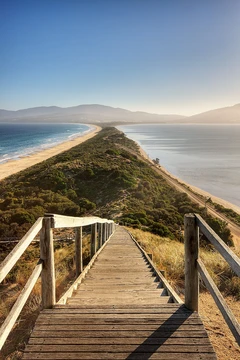
Isthmus of Corinth
Narrow land bridge separating Peloponnese from mainland Greece.

The Isthmus of Corinth is the narrow land bridge connecting the Peloponnese peninsula with the rest of mainland Greece, near the city of Corinth. It has been historically significant as a dividing line between regions and as a site of repeated attempts to construct a canal.
- width
- 6.3 km (3.9 mi)
- location
- Near Corinth, Greece
- bodies_of_water
- Gulf of Corinth to the west, Saronic Gulf to the east
- notable_ancient_feature
- Diolkos stone ramp
- defensive_structure
- Hexamilion wall
Lore & Background
In the first century AD, the geographer Strabo noted a stele on the Isthmus bearing two inscriptions: one facing east reading 'Here is not Peloponnesus, but Ionia' and one facing west reading 'Here is Peloponnesus, not Ionia.' Plutarch ascribed the stele's erection to the Attic hero Theseus. The isthmus was known in the ancient world as the landmark separating the Peloponnese from mainland Greece. The idea for a canal to bypass the Peloponnese was long considered by ancient Greeks. The tyrant Periander attempted to build a canal in the 7th century BC but abandoned it due to technical difficulties, instead constructing a simpler stone ramp called the Diolkos. Under Roman rule, Julius Caesar foresaw advantages, and engineers under Tiberius tried to dig a canal but lacked modern equipment, resorting to rolling boats across on logs. Today, two road bridges, two railway bridges, two submersible bridges, and a military emergency bridge cross the canal. The ancient Diolkos trackway still exists nearby, and the Hexamilion wall, a Roman defensive wall, is located close to the canal.
Reader's Guide
The Isthmus of Corinth holds enduring significance as both a geographical boundary and a testament to human engineering ambition across millennia. Its narrow width made it a natural dividing line between the Peloponnese and mainland Greece, as commemorated by the ancient stele. The surviving Diolkos, a stone portage ramp, offers rare archaeological evidence of ancient overland ship transport. The Hexamilion wall further underscores the isthmus's strategic importance as the only land route into the Peloponnese. Today, the Corinth Canal makes the Peloponnese an island, while preservation concerns for the Diolkos highlight ongoing tensions between modern infrastructure and heritage protection. The isthmus thus encapsulates layers of Greek, Roman, and modern history in a single narrow strip of land.
Did You Know?
- The Isthmus is 6.3 km (3.9 mi) wide.
- A stele on the isthmus bore inscriptions marking the boundary between Peloponnesus and Ionia.
- The first canal attempt was by the tyrant Periander in the 7th century BC, who instead built the Diolkos stone ramp.
Frequently Asked Questions
What is the Isthmus of Corinth?
It is a narrow strip of land roughly 6.3 kilometers wide that links the Peloponnese peninsula to the rest of mainland Greece, situated just outside the city of Corinth. The Gulf of Corinth lies to its west and the Saronic Gulf to its east.
What role does the Isthmus of Corinth play geographically?
It serves as the sole natural land connection between the Peloponnese and the Greek mainland, making it a persistent chokepoint that has shaped trade routes, military campaigns, and regional identity for thousands of years.
Why is the Isthmus of Corinth historically significant?
Its strategic position made it a repeated target for canal-building projects and a natural defensive line, as evidenced by both the ancient Diolkos stone ramp and the later Hexamilion wall that guarded the crossing.
What ancient feature is associated with the Isthmus of Corinth?
The Diolkos, a paved stone ramp stretching across the isthmus, allowed vessels to be hauled overland between the two gulf sides, predating any canal by roughly two millennia.
More in Peninsulas And Isthmuses 1-24
Spotted an error? Know more?
This is a living reference — every entry is fact-audited, and reader corrections feed straight into our audit queue. Suggest an edit · See this site's audit record